This brief supports the respondents and highlights the real-world challenges posed by laws that allow ballots to be received and counted after the federally mandated Election Day. As a nonpartisan organization dedicated to promoting secure, transparent, and accountable elections, C4NJEI draws on its extensive experience in election oversight, research, and advocacy.
The brief underscores how similar laws in New Jersey and New York have led to prolonged delays in vote counting, certification, and resolution of close races, ultimately eroding public trust in the system.
The Case and Its Implications
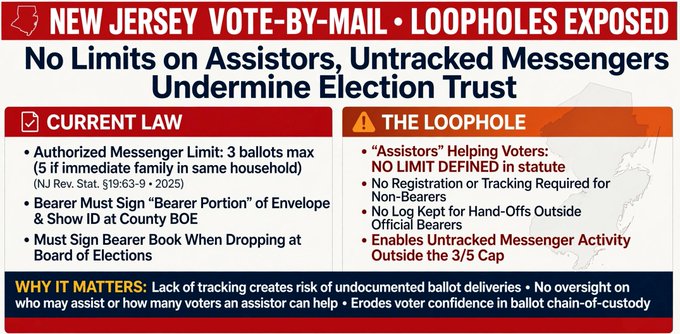
The Supreme Court case centers on Mississippi's statute permitting the counting of ballots received up to five days after Election Day. C4NJEI's brief argues that such extensions contradict Congress's intent for a single, uniform Election Day, as established in federal law. By sharing insights from New Jersey's own experiences under N.J. Stat. §19:63-22—which allows un-postmarked ballots to be accepted up to six days post-election—the brief illustrates the practical pitfalls of these policies. New Jersey has seen routine delays in high-profile elections since implementing extended ballot receipt periods. For instance:
- In the 2020 Seventh Congressional District race, results remained uncertain for over a week, with candidate Tom Kean Jr. conceding only on November 19—16 days after Election Day.
- The 2021 gubernatorial contest between Phil Murphy and Jack Ciattarelli dragged on due to a surge in mail-in ballots and provisional votes, fueling rumors and uncertainty amid an estimated 550,000 mail ballots and 70,000 provisionals.
- More recently, in 2024, Atlantic County failed to certify results on time, still tallying ballots 21 days after the election.
- Even the February 5, 2026, special primary for New Jersey's 11th Congressional District saw delays, with Tom Malinowski conceding to Analilia Mejia on February 10, and counting continuing into February 11.
The brief also references New York's 2020 22nd Congressional District race, where absentee ballot adjudication under a seven-day post-Election Day window left the seat vacant for months. Claudia Tenney was not sworn in until February 11, 2021—three months after the election—leaving constituents unrepresented as the 117th Congress convened.
The Impact on Voter Confidence
Citing research from Yale and the University of San Diego, the brief notes that delays in reporting results inherently foster distrust among voters, even without external misinformation. These extensions not only prolong uncertainty but also complicate procedural safeguards, chain-of-custody, and timely dispute resolution—core elements of fair elections.
C4NJEI's mission is to ensure that every lawful vote is counted accurately and transparently while upholding the finality of Election Day. This amicus brief represents our commitment to these principles, providing the Court with grounded, practical perspectives from states like New Jersey where such laws have been tested in real elections.
Looking Ahead
The Supreme Court's decision in this case could have far-reaching effects on election administration nationwide, including in New Jersey. We encourage our supporters and fellow citizens to stay informed and engaged in protecting election integrity.
For the full text of the amicus brief, click here or contact us at info@c4njei.org